
Connector Applicability
|
Applies to Source Connectors |
Any source system with record types containing a manufacturer attribute/value |
|---|---|
|
Applies to Destination Connectors |
ServiceNow |
Assumptions
These instructions assume you have already setup a source connection in CI Sync for ServiceNow.
Pre-Read
Syncfish recommend customers read the following documentation before changing the Connection Setting/s described below.
-
Rule 5a – Synchronization of Manufacturer, Carriers, and Vendors (including Null) on the Parent CI
-
Rule 5b – Synchronization of various Manufacturers on the Child Records of the CI
Locating and Amending the Connection Setting in the CI Sync UI
-
Navigate to the Settings pageNavigate to the Settings page
-
Under the Destination Connections heading (list), locate your ServiceNow connection (it will be either a Non-PROD “TEST” connection or the “PROD” connection depending on which one you need to amend).
-
Click the Update link on the right hand side of the ServiceNow connection.
-
Scroll down and locate the Additional Settings Heading and view the Individual Connectoin Setting related to this guide.
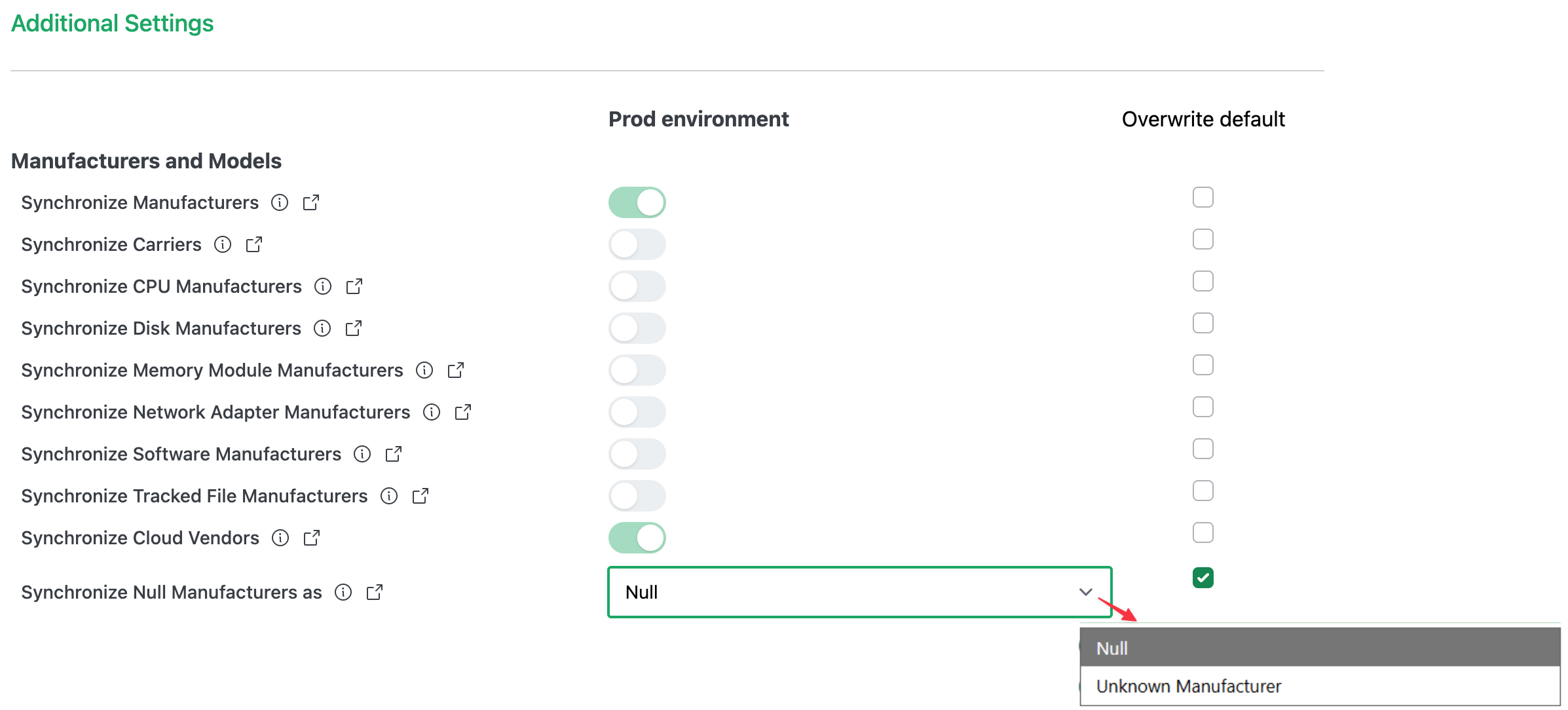
The screen shot is provided only as sample to assist when reading this page. The state of your own CI Sync UI will depend on whether you are starting from the CI Sync default position or if you have already amended one/more of the settings.
-
Tick the Override default box/boxes and then use the sliders related to the individual settings. The following table elaborates any further information about these particular settings.
|
Setting |
Type |
Additional Notes |
|
Synchronize Manufacturers |
Slider |
When enabled, the Manufacturer field is synchronized to cmdb_ci records. For example: hardware manufacturers of equipment read from Lansweeper and other sources of hardware assets. |
|
Synchronize Carriers |
Slider |
When enabled, the Carrier (Vendor) field is synchronized on cmdb_ci records. For example:
|
|
Synchronize CPU Manufacturers |
Slider |
When enabled, the CPU Manufacturer field is synchronized on cmdb_ci records. |
|
Synchronize Disk Manufacturers |
Slider |
When enabled, the Manufacturer field is synchronized on cmdb_ci_storage_device records. |
|
Synchronize Memory Module Manufacturers |
Slider |
When enabled, the Manufacturer field is synchronized on cmdb_ci_memory_module records. |
|
Synchronize Network Adapter Manufacturers |
Slider |
When enabled, the Manufacturer field is synchronized on cmdb_ci_network_adapter records. |
|
Synchronize Software Manufacturers |
Slider |
When enabled, the Manufacturer field is synchronized on cmdb_ci_spkg or cmdb_ci_business_app records. For example:
|
|
Synchronize Tracked File Manufacturers |
Slider |
When enabled, the Manufacturer field is synchronized on cmdb_ci_config_file_tracked records. |
|
Synchronize Coud Vendors |
Slider |
When enabled, the Vendor field in ServiceNow will be populated with the vendor value defined in the related connection setting for each individual source connector. For example: The vendor value for AWS is controlled by the AWS Source System Connection Setting explained here: Vendor Name for AWS. |
|
Synchronize Null Manufacturers as |
Choicelist |
By default, CI Sync passes through a Null manufacturer (or carrier or vendor or similar) value to the main/parent CI. Therefore, the CI will have no foreign key reference between the individual CI and the Manufacturer Master Data table (i.e. the core_company table) in ServiceNow. If “Unknown Manufacturer” is selected, CI Sync persists a reference to the “Unknown Manufacturer” record in the core_company table (i.e. persists the sys_id of the “Unknown Manufacturer” record in the core_company table against each CI where the incoming manufacturer is Null in the source system). |
-
After modify the settings, scroll to the bottom of the page, tick the “I consent…” checkbox and finally click the Save connection button.
-
You can now run a sync job and the amended settings will be applied causing the CI Sync Data Sync rules to be modified accordingly.
Importantly
Make sure you consciously override the setting against either your TEST or PROD environment (i.e. your TEST vs PROD sync jobs).
For more information on how to use TEST vs PROD Connection Settings please read Understanding the use of CI Sync Connection Settings.
Syncfish strongly recommend making changes for TEST environment/sync jobs first. Only modify PROD related settings after thoroughly validating the intended results in TEST.