
Rule Synopsis
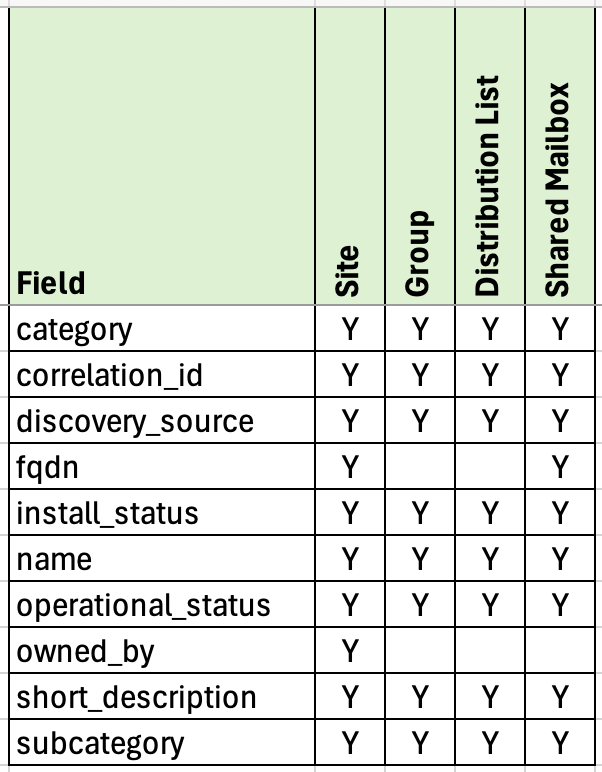
These are the rule/s that determine how Microsoft 365 Attributes/Fields are mapped to CMDB CI Attributes/Fields for each type of Microsoft 365 Resource Type.
Rule Details and Defaults
Please read the table below (which show the default mappings).
Special Handling of the Description Attribute
By default, CI Sync reads a number individual attributes from the Microsoft 365 Resources and combines these into line seperated values in the Description field of the related CI in ServiceNow.
See below for the list of values CI Sync writes to the Description of each CI using attributes from Microsoft 365 Resources.
For Microsoft 365 Groups and Distribution Lists
ID: id
Description: description
Date Created: createdDateTime
Security Enabled: securityEnabled
Mail Enabled: mailEnabled
For Shared Mailboxes
ID: id
UPN: userPrincipalName
Mail Nickname: mailNickname
Aliases: proxyAddresses
Date Created: createdDateTime
Override Options
Context
Customers may consider changing the attribute/field level mappings (e.g. to add or remove attributes/fields).
Note: The attributes/fields available in ServiceNow are specific to target CI Table/Class (based on the CI Class inheritance model baked into the ServiceNow CMDB. Customers wishing to amend the attribute/field level mappings may have broader implications on the target CI Table/Class used for a given Microsoft 365 Resource type. For this reason, customers should engage Syncfish to discuss the implications of changing the default attribute/field level mappings.
Options
-
The field mappings (and transformation of data for persistence into the destination fields) can be amended for each Microsoft 365 Resource Type.
Overriding via Connection Settings
Not Available - Requires a Custom Data Sync Rule (and therefore a Syncfish Support Plan to modify the default behaviour)
Additional Information
N/A
Related Rules
N/A